Think about the only four parts of your vehicle that actually touch the road. They are not your heavy steel frame or high-tech airbags. There are four palm-sized patches of rubber spinning at sixty miles per hour. When you look at it that way, taking five minutes to inspect your tires seems like common sense.
Yet, most of us take our tires for granted until a dashboard light flashes or a loud thumping noise ruins a morning commute. In 2026, modern cars pack incredible driver-assist tech, but none of it matters if your rubber loses its grip. Bad tire care is a straight shot toward blown tires on the interstate and scary hydroplaning slides on wet pavement.
The National Highway Traffic Safety Administration reports that tire failures cause roughly 11,000 crashes and over 600 deaths each year in the United States. Taking charge of your own vehicle safety takes very little effort, and it pays off immediately in better handling, fewer repair bills, and real peace of mind.
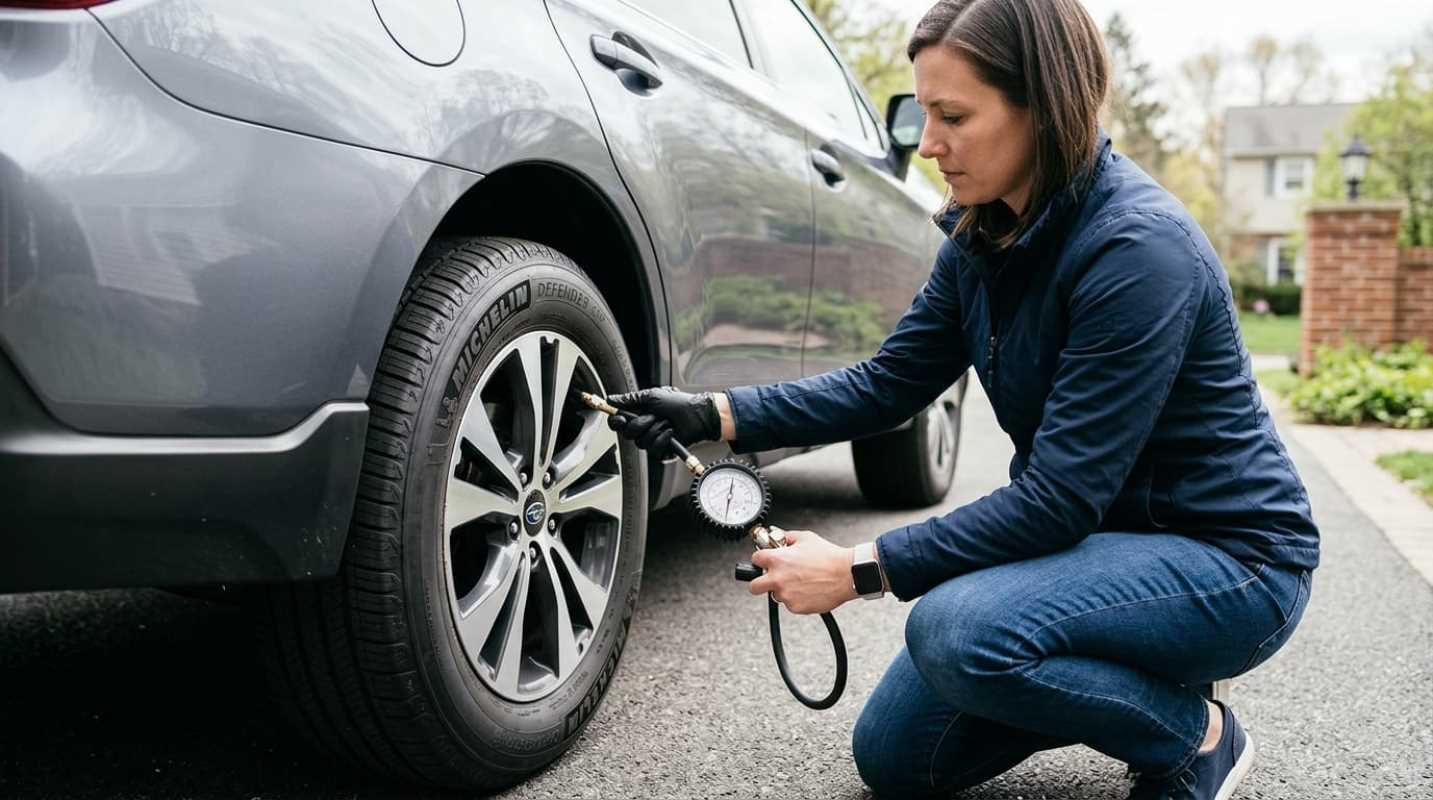
Mastering Tire Pressure and Finding Your Recommended PSI
Have you ever pulled up to a gas station air pump, glanced at the numbers stamped on the side of your tire, and started filling? Stop right there. That number stamped into the rubber sidewall is the maximum pressure the tire can hold before failing. It is definitely not the pressure your car needs to drive safely.
To find your real target, open your driver side door. Look right on the door frame, known as the B-pillar, for a bright yellow-and-white sticker. That factory placard tells you the exact pounds per square inch, or PSI, engineered specifically for your vehicle weight and suspension. If the sticker says 34 PSI, that is your target.
Timing also matters. Always check your pressure when tires are cold. That means first thing in the morning, or after the car has been parked for at least three hours. Driving heats up the air trapped inside your tires, which can raise your reading by 3 to 5 PSI artificially. If you set your pressure while the tires are hot, they will actually end up under-inflated once they cool down.
Here are a few quick rules of thumb to keep in mind
• The Temperature Rule: Tire pressure drops or gains roughly 1 PSI for every 10-degree Fahrenheit change in ambient weather. A cold snap overnight can suddenly leave you riding dangerously low.
• Natural Air Loss: Tires lose about 1 PSI every month through normal seepage. Skipping inspections for three months means your tires are almost certainly dragging.
• The TPMS Trap: Modern Tire Pressure Monitoring Systems are handy, but federal rules only require the dash alert to light up when a tire is 20% to 25% below spec. By then, your gas mileage has already tanked and your tires are running hot.
Keeping your tires properly pumped pays you back at the pump too. According to the U.S. Department of Energy, dropping just a few PSI cuts your fuel economy, adding up to a 3% penalty on fuel efficiency if you leave them neglected.¹
The Penny Test and Beyond for Evaluating Tread Depth
Proper pressure keeps your tires in shape, but tread depth is what keeps you stuck to the asphalt. New passenger tires typically start life with 10/32 to 11/32 of an inch of tread grooves. Those grooves act like water channels, throwing moisture out from underneath so the rubber stays glued to the pavement.
As miles rack up, those channels wear smooth. Once they flatten out, water has nowhere to go, and your car floats on top of the puddle instead of gripping through it.
You have probably heard about the classic penny test. You turn a penny upside down and stick Abraham Lincoln's head-first into a groove. If you can see the top of Lincoln's head, your tread is at or below 2/32 of an inch. That is the legal bare minimum across the country.
The problem? Waiting for the penny test to fail is playing with fire. Research from AAA showed that passenger cars riding on 4/32-inch tires took an extra 87 feet to stop on wet pavement from 60 mph compared to cars on fresh tires.² That is nearly six car lengths of extra sliding distance. In real life, that gap is the difference between a close call and a devastating rear-end collision.
Use these smarter methods instead
• The Quarter Test: Grab a quarter and turn George Washington upside down in the tread. If the top of his hair shows, you are below 4/32 of an inch. That is your cue to start shopping for a new set of tires.
• A Dedicated Depth Gauge: Spend five dollars on a pocket tread gauge. Push the pin into the groove and get an exact readout in seconds. Check three spots across the tire: the outer shoulder, the center strip, and the inner shoulder.
• Wear Indicator Bars: Look deep into your tread grooves. You will see small, raised rubber bridges sitting down inside the channels. If your main tread wears down even with those little bars, your tires are completely bald.
Diagnosing Uneven Wear and Rotation Approaches
Tread patterns tell a story. If you run your bare hand across the surface of your tires, the rubber should feel even and uniform. When parts of the tire wear out faster than others, your car is trying to tell you that something mechanical is wrong
• Wear on Both Outer Shoulders: Both edges are worn thin while the center retains deep tread. This is classic under-inflation because the car weight is riding entirely on the tire edges.
• Wear Down the Center Strip: The middle of the tire is bald while the edges have plenty of life. This happens when tires are consistently over-inflated, bulging the crown outwards.
• Wear on Just One Edge: If only the inner or outer edge is bald, your alignment is out of whack. A bent strut or improper camber angle is leaning the wheel too hard on one corner.
• Feathered Edges: The tread blocks feel smooth when sliding your hand one direction, but feel sharp and jagged the other way. This signals toe misalignment, meaning your wheels are pointed slightly inward or outward, dragging sideways down the road.
• Cupped or Scalloped Dips: Random hills and valleys across the tire point to shot shocks, blown struts, or severe wheel imbalance bouncing the tire down the pavement.
To stop minor wear from turning into scrap rubber, rotate your tires every 5,000 to 7,500 miles. Front-wheel drive cars put extra friction on the front axle, while rear-wheel drive cars push hard from the back. Rotating them shares the workload equally.
If you drive an electric vehicle, pay even closer attention. EVs hit tires with instant torque off the line and weigh thousands of pounds more due to heavy batteries. Tire makers note that EV tires often wear out 20% to 30% faster than standard gasoline models.³ Rotating them every 5,000 miles matters to avoiding an early trip to the tire shop.
To make checking your tires easy, keep a couple of simple tools in your trunk or glove compartment so you never have to guess.
Creating a Routine for Long-Term Tire Health
Car care does not need to eat up your weekend. Pick one fixed morning every month, like the first Saturday, to run through a quick walk-around. Grab your pressure gauge before starting your car, read all four tires, and check the spare tire resting in the trunk.
Jot down your readings in a simple note on your phone. Keeping a quick log helps you spot a slow leak from a hidden nail long before you wake up to a flat in your driveway. Check your tread with a quarter, take a quick peek across the rubber for odd wear shapes, and head on with your day.
Taking care of your tires saves you hundreds of dollars in wasted fuel and early replacements. More importantly, it keeps your car under control when you need it most.
Sources:
1. Tire Pressure and Gas Mileage
https://www.firestonecompleteautocare.com/blog/tires/tire-pressure-and-gas-mileage/
2. Tread Lightly: Worn Tires Put Drivers at Risk
https://newsroom.aaa.com/2018/06/tread-lightly-worn-tires-drivers-risk/
3. EV Tire Pressure and Maintenance Guide
https://www.michelinman.com/auto/auto-tips-and-advice/electric-mobility-guide/ev-tire-pressure-and-maintenance